Is Every Human Being an Ardhanarishwar?
Is Every Human Being an Ardhanarishwar?
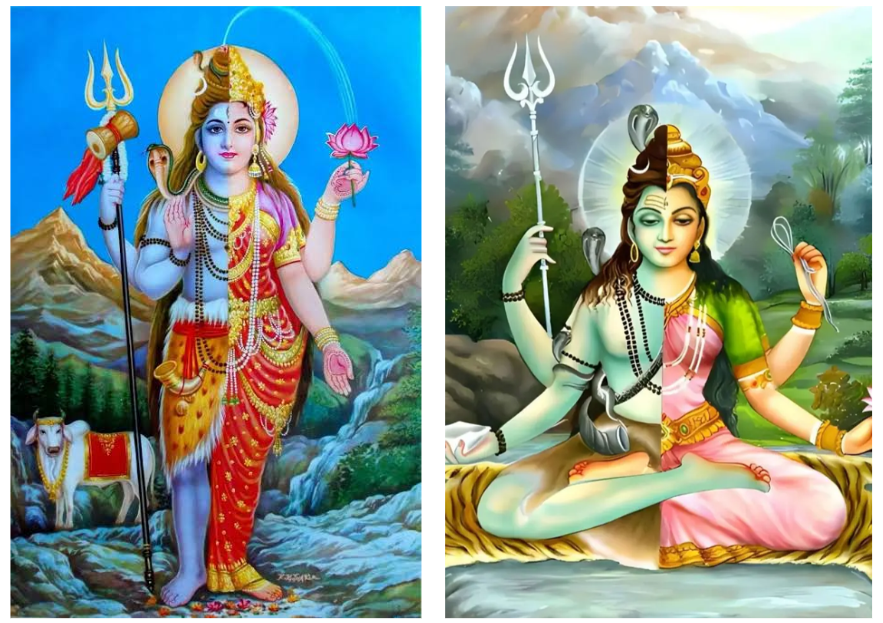
Ardhanarishwar is traditionally represented as a unified form of Shiva and Parvati, half Shiva and half Parvati. But could this ancient symbol have a deeper message about the human being?
What if the stories and forms of Shiva, Parvati, Vishnu, Brahma, and other divine figures are not merely religious symbols, but also offer insights into human life, relationships, behaviour, and how we function?
The universe often communicates through symbols, forms and mythological stories. We can view them as thought-provoking representations that encourage us to look within, to understand our inner self, our relationships, our responsibilities, and our interaction with the world.
One powerful symbolic representation is Ardhanarishwar. See Fig. 1 & 2 below:
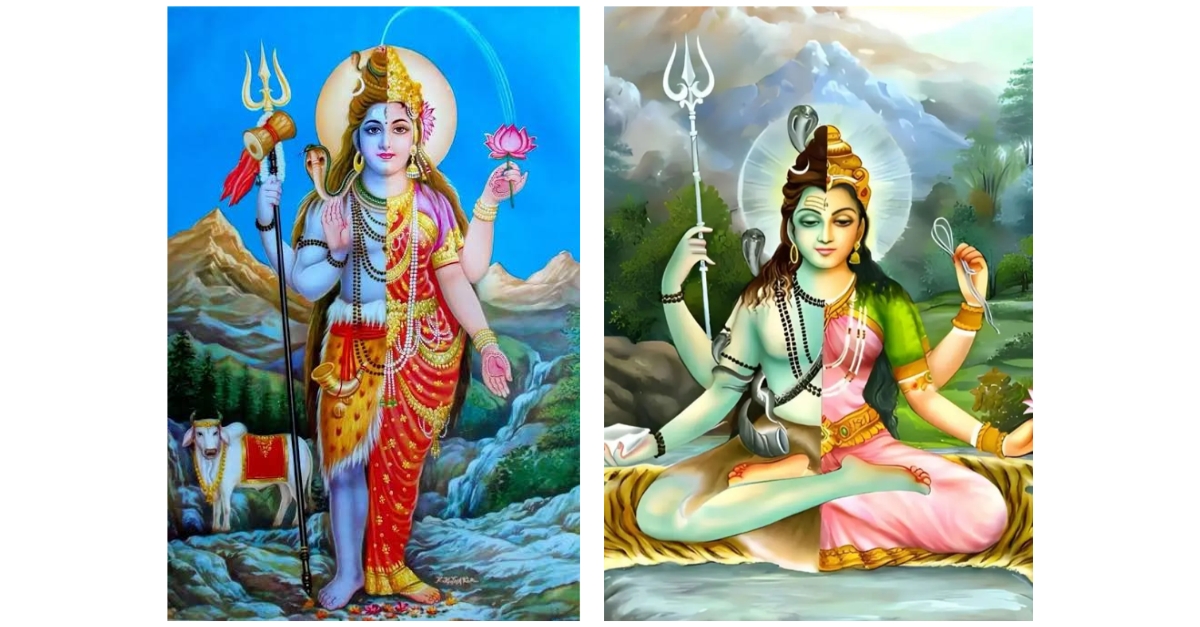
Fig. 1 & Fig. 2: Shiva and Parvati depicted as a unified composite form, half Shiva and half Parvati, vertically divided into two complementary halves.
The Principle of Pairing Opposites
One idea explored in Secrets of the Universe is that nature expresses itself through complementary forces that are paired, equal yet opposite. We see this principle in male and female, inner and outer, day and night, husband and wife, and many other seemingly contrasting aspects of existence.
Science also provides familiar examples. Chemistry gives us acidic and alkaline properties, as well as protons and electrons. Physics describes action and reaction as equal and opposite, while magnetic systems contain opposing north and south poles.
Hindu symbolism similarly presents contrasting forms. Vishnu is traditionally portrayed in royal splendour, associated with the cosmic ocean, while Shiva appears as an ascetic dwelling among the snow-clad mountains. Their contrasting appearances need not imply conflict; they can instead be understood as complementary expressions of a larger whole.
The Human Being as a Two-System Body
Following this principle, we present that a human being can be viewed as comprising two closely connected systems:
The Internal Body System, i.e. the “Master”
The External Body System, i.e. the “Captain”
The Captain is our visible external self; the part that acts, interacts with the world, uses its talents, performs duties, earns, serves, participates in society and manages the practical responsibilities of life.
In this presentation, the Master represents the internal body system: the complex biological mechanisms and inner processes that regulate the body and continuously communicate its needs to the external self, i.e. the Captain.
Consider something as simple as hunger. When the body's energy reserves fall, the internal system generates a hunger signal. The Captain responds by seeking and consuming food. When the body's water level falls, the Master generates a thirst signal, and the Captain drinks water. Similarly, signals relating to elimination, fatigue and the need for rest guide the Captain's actions.
The body also possesses remarkable natural mechanisms for repair and recovery. When we experience minor injury, pain, fever or other disturbances, the body attempts to restore itself. When a condition exceeds its natural capacity for recovery or requires additional intervention, the Captain seeks external medical assistance.
Thus, the Captain continually responds to signals from the Master, while the Master depends upon the Captain to fulfil its requirements.
Together, they form a dynamic partnership that sustains human life.
Beyond Male and Female
The Master-Captain relationship can also offer another way to view traditional feminine and masculine principles.
In a traditional family model, the housewife manages the home, nurtures the children and looks after the family's internal needs, while the husband traditionally takes responsibility for engaging with the outside world and procuring resources. These roles illustrate two complementary functions: internal management and external action.
In our analogy, the Master represents the internal principle of guidance, regulation, nurturing and conscience, while the Captain represents action, interaction and engagement with the external world.
Importantly, these principles are not restricted to biological gender. Every individual, whether male or female, contains both dimensions.
This gives Ardhanarishwar a deeper interpretation: the masculine and feminine are not merely physical identities; they can also represent complementary principles operating within every human being.
Ardhanarishwar: Presented as Half Shiva and Half Parvati
The traditional half-Shiva, half-Parvati image is a powerful graphical representation of an idea that is difficult to depict physically. It need not mean that a human being is literally divided into two vertical equal halves.
Instead, it can represent two complementary dimensions coexisting within one complete human being, the inner and the outer, i.e., the Master and the Captain.
In our interpretation, Shiva symbolises the masculine principle, or Captain, the external self that acts in the world, while Parvati symbolises the feminine principle, or Master, the internal self that guides, regulates, and responds.
The graphics developed in Secrets of the Universe attempt to make this relationship easier to visualise: the internal and external systems are not separate individuals but interconnected dimensions of one human being. See Fig. 3 below:
 Fig. 3-a, b & c: Graphic of male in blue and female in pink. A human has an internal body that seamlessly merges with the external body via the brain.
The Kundali and the Inner Master
From the perspective of Vedic Astrology, the first house (Lagna) traditionally represents the individual, the physical person and the self. In the astrological framework, it symbolically represents the Captain, i.e., the external system through which we interact with the world.
The seventh house, traditionally associated with the spouse and partnerships, may be explored symbolically as representing the Master, i.e., the complementary internal system that provides prompts, responses and guidance from within.
Thus, the seventh house may be contemplated as the voice of conscience or inner guidance and prompts that influence the Captain in carrying out daily activities and responsibilities.
Every Human Being as Ardhanarishwar
The central idea can therefore be expressed simply:
Every human being can be understood as an Ardhanarishwar, a complete being in whom complementary inner and outer systems continuously interact and support one another.
The Captain acts.
The Master guides.
The Master signals.
The Captain responds.
When these two dimensions work in sync and harmony, thought becomes action, inner guidance becomes responsible behaviour, and the individual functions as an integrated whole.
Perhaps, therefore, Ardhanarishwar is not only an ancient representation of Shiva and Parvati. It invites us to recognise something within ourselves:
We are each a union of the inner and the outer, the Master and the Captain, the two complementary dimensions working together in sync, to help us navigate life and fulfil our responsibilities.

 SAMS DIGITAL